

Community
Half a Century Cold
By Craft Lemon
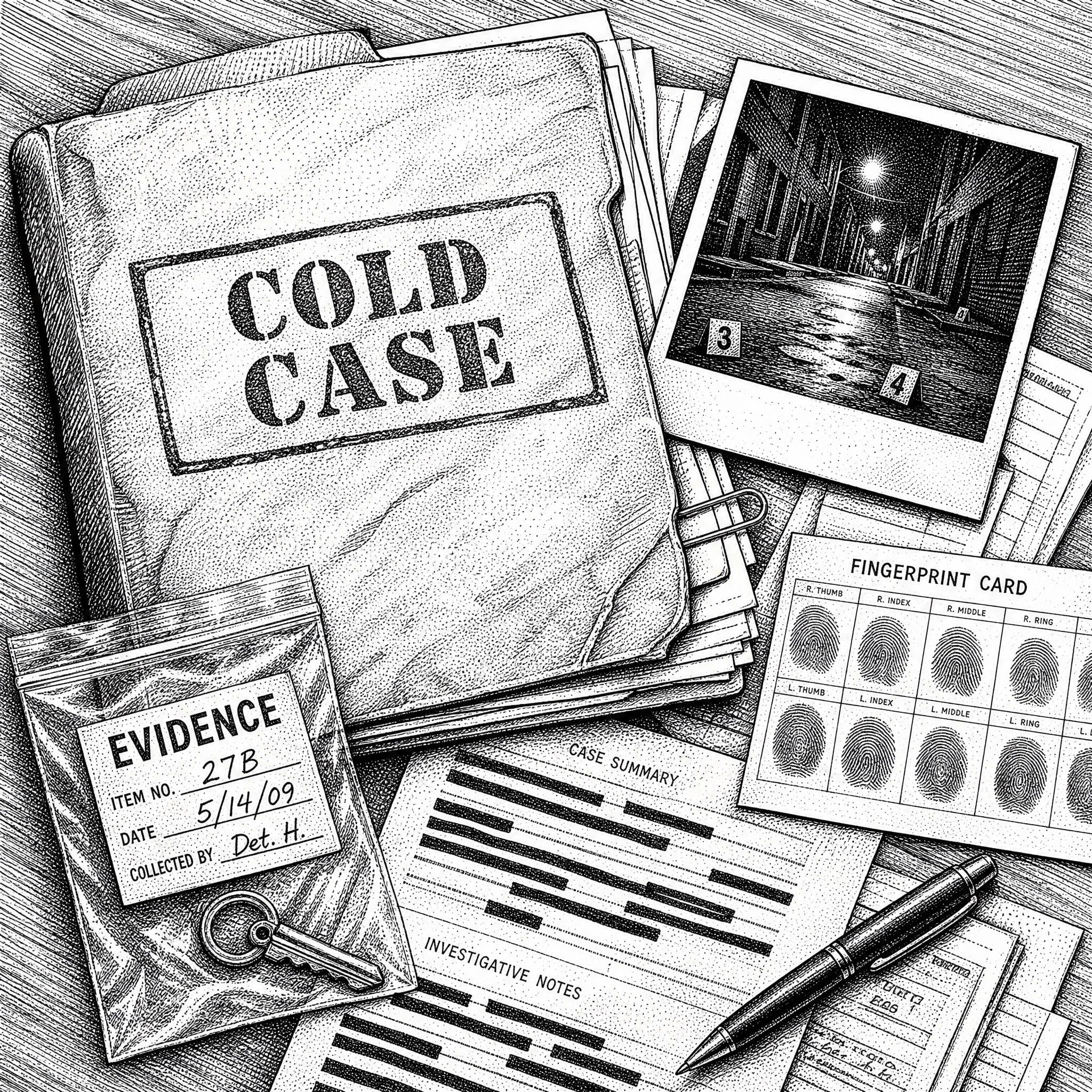
More than two dozen unsolved homicides. Eleven missing people. A former mayoral candidate in a Tennessee jail. What Gainesville hasn’t closed, and what the files reveal about who gets searched for.
The Gainesville Police Department keeps a list.
It runs from 1974 to 2018, give or take. Some entries are paragraphs long. Some are six words and a placeholder photograph because the file is too thin to say more. The newest case is six years old. The oldest is fifty-two.
A few miles east on SE Hawthorne Road, the Alachua County Sheriff’s Office keeps its own. Older in places. Just as unmoved.
Between them, the two agencies are publicly carrying more than two dozen unsolved homicides and roughly that many open missing-persons files. A few of those names are nationally known. Most of them are not. The pattern of which is which tells you a great deal about how a homicide gets solved in Florida.
This is not a piece about the Gainesville Ripper. Danny Rolling confessed and was executed. That case is closed. This is a piece about the files that are still open, the new entries from the past two years, and a former local candidate who managed to become a national crime story before most of his neighbors knew his name.
The Rosenthal File
In June 2022, Adam Arthur Rosenthal filed to run for mayor of Gainesville. He had moved to the city from Wisconsin a decade earlier to work in tech, and ran on solar power, public transit, and reducing fossil fuel dependency. He spent no money on the campaign and received no monetary contributions, according to the Alachua County elections office, which recorded him receiving less than 2 percent against eight other candidates. He received 236 votes. Harvey Ward won.
In a 2022 guest column for the Gainesville Sun, Rosenthal described himself as formerly homeless and a survivor of domestic violence. In a separate interview with the Greater Gainesville Chamber of Commerce, he said he had become homeless in 2018.
He was reported missing on June 18, 2024. GPD spokesperson Brandon Hatzel told Mainstreet Daily News at the time: “We haven’t had too much involvement with the case so far.“
The case picked up considerably six months later.
On November 26, 2024, Giles County, Tennessee, sheriff’s deputies found a man stabbed to death on a property near Pulaski owned by the religious sect known as the Twelve Tribes. The victim was Darren Cody Gambrel, 25, also a sect member. Rosenthal was arrested the same day and charged with criminal homicide, aggravated assault, and tampering with evidence.
While in Tennessee custody, Rosenthal told investigators he had information about a separate killing in Macon, Georgia. The Bibb County Sheriff’s Office sent investigators to interview him. They left convinced. On December 4, 2024, Bibb County charged him with the May 24, 2024, murder of Albert Kenneth Knight Jr., 59.
Knight was a homeless man. He was sleeping in an alley between Poplar and Second streets in downtown Macon when surveillance video captured a man dropping a cinder block on his head. Investigators released footage of a white man in glasses wearing a green “Hilton Head Island bike shop” T-shirt walking around Macon in the hours after the killing. Nobody in Macon could place him. A Giles County lieutenant later told 13WMAZ that Rosenthal admitted to being on foot, accepting rides from strangers, and passing through Macon when he killed Knight, whom he did not know.
GPD opened its own investigation. The opening was not what some people assume.
“After he went missing and we posted his image as a missing person on our Facebook page, a member of our community identified him as a suspect in sexual battery,“ Detective Kristen Hall told WCJB News in December 2024. The investigation began after the missing-person post, not before it. The detective was clear about the sequence on the record, and the timeline matters: there is no evidence in any publicly available reporting that Rosenthal left Gainesville under a cloud of pending criminal allegations. He left, and then the allegation came forward.
In the same interview, Detective Hall asked the public to refocus. “As much focus as we want to put on Adam, the people who we should really be thinking about right now are the people who are his victims of not only violent sexual acts but also those who have lost their lives,“ she said. GPD has asked anyone with knowledge of crimes connected to Rosenthal to contact Detective K. Hall at 352-393-7663 or Sergeant J. Pandak at 352-393-7734. Sexual assault survivors can also report at ReportRapeGainesville.org or by calling the non-emergency line at 352-955-1818.
As of May 2025, one year after Knight’s death, Rosenthal had been indicted in the Tennessee case but had not yet been indicted in Macon. The Bibb County case remained open.
What Gainesville has not closed
The Rosenthal file is unusual because it generated a charged suspect quickly. Most files on the GPD board did not.
Officer Scott Baird, February 12, 2001
Officer Scott Baird, 23, responded to a report of an object blocking the road in the 1900 block of NW 16th Terrace around 1 a.m. He found a metal batting cage in the street. He turned on his emergency lights and called for help moving it. While he waited, a 17-year-old male driving north on NW 16th Terrace struck the cage, which struck Baird. He died at the scene.
Detectives believe players from a rival baseball team of Gainesville High School moved the batting cage into the road. No one has been charged. The City of Gainesville is offering up to $50,000 for information leading to an arrest and conviction, the single largest standing reward in the case file.
Treva Gernannt and Emily Wallace, December 1, 1994
A house fire at 1031 SE 3rd Avenue brought firefighters to the home of Treva Gernannt, 88, and Emily Wallace, 74. The roof had collapsed on the bodies. The fire department first attributed it to the gas heater exhaust igniting the attic. Then the medical examiner found stab wounds on Gernannt’s neck.
Wallace was last seen at church the previous evening. Gernannt had stayed home with an illness.
Eileen Jones, January 13, 1990
A neighbor went to check on Eileen Jones, 68, at Windmeadows Mobile Home Park on Southwest Archer Road, and found her front door unlocked and her body inside. The Alachua County Sheriff’s Office worked the case actively in 1990. January 2025 marked 35 years. No arrest.
Wende Ellinger, March 17, 2005
A fire at her residence at 10207 SW 84th Avenue in Kanapaha Highlands brought first responders to find Wende Ellinger dead. Her injuries pre-dated the fire. Ellinger had three small children, who were not home that night.
Judy MacFarlane, 1992
Judy MacFarlane, a 30-year-old single mother of four, attended a Monday-night Bible study at United Pentecostal Church in Gainesville on January 13, 1992. A light rain was falling. Two church members offered her a ride. She declined, said she lived close, and walked.
She was never seen alive again. On June 26, 1992, a Department of Transportation worker found her body in a retention pond on the north side of the city, three-quarters of a mile from her home. Because of the length of time the remains had been in the water, the medical examiner could not determine cause of death.
Family members complained publicly that the sheriff’s office, which had mobilized hundreds of volunteers for the search for University of Florida student Tiffany Sessions, was treating MacFarlane’s case differently. Investigators replied that MacFarlane had disappeared once before and had cashed a check that day, and that the circumstances suggested she may have left voluntarily. According to First Coast News, the case sat largely uninvestigated as a homicide until ACSO Cold Case Detective Kevin Allen reopened it in 2015.
That comparison has stuck around. Which brings us to Sessions herself.
Tiffany Sessions, February 9, 1989
The most-searched missing-person case in Florida history. A UF student, 20, who went for a walk and never returned. Her remains have never been found.
In 2014, Sheriff Sadie Darnell publicly named Paul Eugene Rowles, a convicted murderer who died of cancer in prison in February 2013, as the prime suspect. A cold-case detective found a notation in Rowles’s prison-cell notebook reading “2/9/89 #2,“ which investigators interpreted as Sessions being his second victim. Rowles’s DNA was later linked to the 1992 rape and murder of UF student Elizabeth Foster.
The named suspect is dead. The remains are still missing. ACSO receives roughly five tips a year on the case. Tiffany’s mother, Hilary Sessions, told WCJB in 2024 that she remains hopeful someone digging a foundation, someday, will find her.
The pattern that the files make plain
You can spend a long time on GPD’s cold-case page before the pattern surfaces, but once you see it you cannot unsee it.
A disproportionate share of Gainesville’s unsolved homicides over the past quarter century share a kind of victim: people who were homeless, dependent on drugs, working in the survival economy, or simply newly arrived in the city without family or routine. They are not, by any reasonable read, the cases that generated press conferences or volunteer search parties. Some of them barely generated news cycles.
This is not a Gainesville-specific phenomenon. Decades of national academic literature on homicide clearance rates have documented that murders of marginalized victims, particularly those without stable housing or close family advocates, are cleared at significantly lower rates than other homicides. Witnesses are harder to find. Physical evidence is harder to recover. Investigators sometimes get less time on each file. The case becomes its own headwind.
Here is what that pattern looks like in the GPD files.
Daniel Adkins, December 6, 2013
Officers responded to a wooded area in the 3000 block of East University Avenue, just east of Cone Park. Several homeless residents had tents and campsites in the woods there. Adkins, partially decomposed, was found hidden under a tarp by one of those residents, not far from his own campsite. The medical examiner determined he had been shot in the head about a week before his body was found.
Angel Harris, June 25, 2011
The body of Angel Harris, 31, was found behind a row of bushes alongside the Sun Center at 235 South Main Street. She had been strangled the night before. She was known to use drugs. She was last seen alive in the area of the St. Francis House, the longtime downtown shelter.
Lisa Lavoice, October 18, 2000
A man walking his daughter to school found her body in a wooded area in the 500 block of NE Waldo Road. She was 30, unemployed, and a known drug user. She had been stabbed and strangled. She was last seen alive at a residence nearby the evening before.
Michael Brooks, October 23, 2018
Children playing in a vacant lot near 1700 NE 8th Avenue found Brooks’s body. He had been shot, likely in the early morning hours. He had arrived in Gainesville only recently and had been spending time in that area.
Earlene Boyd, June 18, 1994
Her body was found face down in the creek at Tumblin Creek Park, off SW 6th Street. She was 23. She was a well-known sex worker who lived and worked in Porters, the historically Black neighborhood adjacent to downtown.
Jay Cecil Thames, Jr., June 8, 2003
A 57-year-old man beaten to death inside his apartment at 1115 SW 3rd Avenue. The front door was unlocked, no sign of forced entry. The case file notes that Thames “had frequent homeless people at his residence” and was last seen by a GPD detective downtown the night before.
Tinia Marie Osborne, last seen November 4, 2004
Listed on GPD’s cold-case missing-persons page. She has had no contact with family since December 2004. Her file describes her as “a habitual drug user and prostitute in the downtown area of Gainesville.“ She has not been found.
Thomas “Tommy” Brown, last seen November 9, 2018
Brown spent time at Grace Marketplace and Dignity Village. Local church members put him up in a hotel in southwest Gainesville on November 8, 2018. On November 9, surveillance video showed him leaving the hotel and buying guitar picks at a local music shop. His personal items were left at the hotel. He never returned, and no one in his life has heard from him since.
Brown’s disappearance is six years old. It would be a particularly hard case to clear at this point, even if a lead surfaced tomorrow.
It is also exactly the kind of case that drives the suspicion, voiced periodically in this city since at least the time of the Sessions complaints, that GPD and ACSO put their best people on cases that come with parents who hold press conferences. That suspicion is not the same as proof of misconduct. It is, however, the natural reaction to a case file in which a UF student gets the largest search in Florida history and a man with no family in town does not generate a known witness.
The reward and the tipline
The City of Gainesville is offering up to $10,000 for information leading to the arrest and conviction of those responsible for any of the cold-case homicides on the GPD list, and up to $50,000 in the Scott Baird case specifically. Tips on those cases go to GPD Detective David Blizzard at 352-393-7710 or blizzarddk@cityofgainesville.org. The general investigations tip line is 352-393-7700.
ACSO’s cold-case investigator is Detective Todd Hand, at 352-367-4164 or thand@alachuasheriff.org. Anonymous tips go to Crime Stoppers at 352-372-STOP.
Tips on Adam Rosenthal go to Detective K. Hall at 352-393-7663 or Sergeant J. Pandak at 352-393-7734. Sexual assault survivors can also report directly at ReportRapeGainesville.org.
What the files are still saying
The case files do not close because no one is paying attention. They close because somebody talks, and someone listens, and somebody else has the time and the will to put both pieces in the same room.
Tommy Brown bought guitar picks on a Friday in November six years ago. Daniel Adkins was found under a tarp not far from his own tent. Treva Gernannt was 88 years old. Officer Scott Baird was 23.
These are not cases on a database. These are names. And they are still listed under “open.“
If you know something, the numbers are above. You do not need to know how the case fits. That is the detective’s job. You only need to know what you saw.